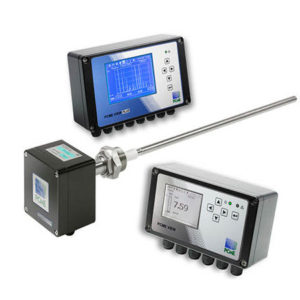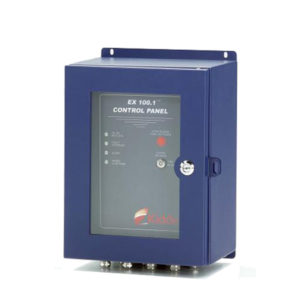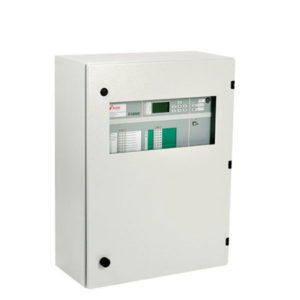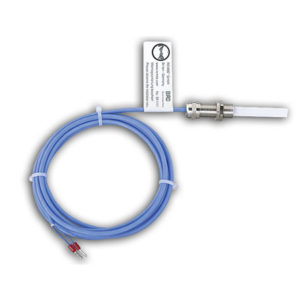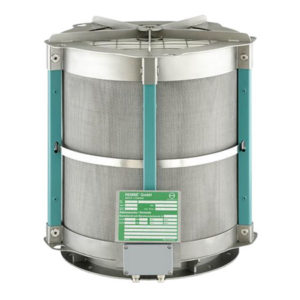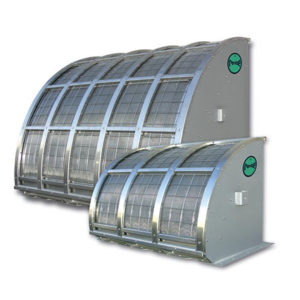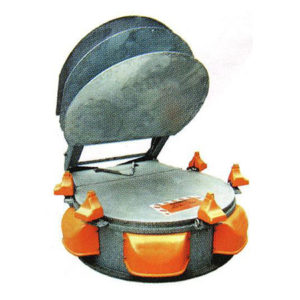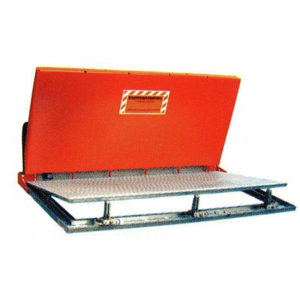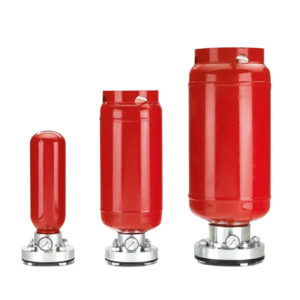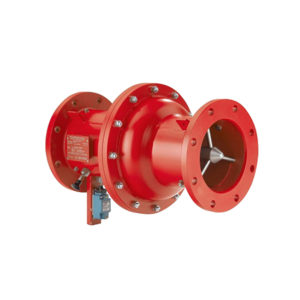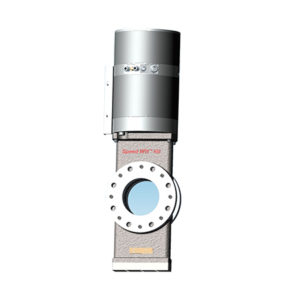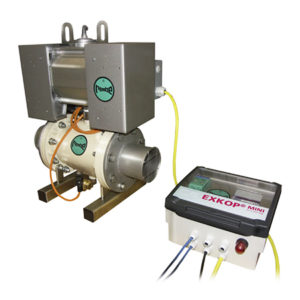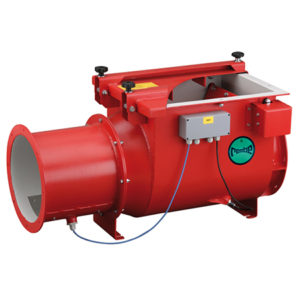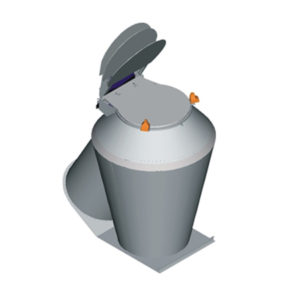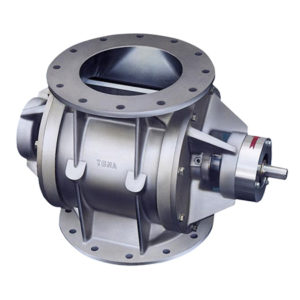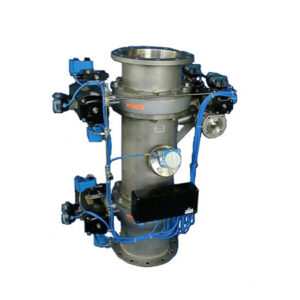



Explosion suppression systems offered by Tessa protects process equipment against explosion effects. The system is designed to detect an explosion in its earliest stages and provide an immediate response so as to extinguish the explosion source before it becomes catastrophic to the plant and personnel.
The basic type of explosion suppression system consists of a dynamic pressure increase sensor, pressure containers with extinguishing agent and an electronic system control unit. The pressure sensor continuously monitors pressure fluctuations inside the explosion-protected equipment. System activation depends on the rate of pressure rise (ΔP/Δt) inside the process vessel, according to the product's explosion characteristic – the Kst constant (value characteristic for a given flammable and explosive product). In the event where the measured ΔP/Δt value corresponds precisely to the product's Kst index, the electronic control system interprets the signal from the pressure sensor as an occurrence of "initial explosion stage" which will trigger an immediate opening of the cylinder with extinguishing powder and its injection into the protected equipment. The total response time, from the moment of detecting the "initial explosion stage" until it is extinguished, is of the order of milliseconds (less than 1 second).
The benefits of an explosion suppression system include:
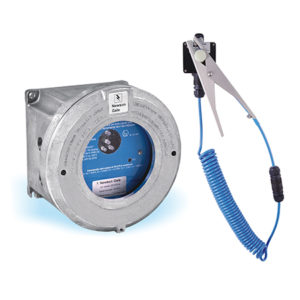
The system is designed to prevent static accumulation and discharge during the loading and unloading of road tankers. Earth-Rite PLUS Dual Mode ensures that correct bonding and grounding procedures are carried out before the transfer process begins. Earth-Rite PLUS Dual Mode conducts a test that verifies a tanker, prior to monitoring for static earthing paths. The system allows for media transfer only when both of these conditions are within pre-set parameters, thereby eliminating the potential for operator error. The local indicator LEDs confirm the presence of a road tanker and earthed condition to the operator, while the built-in voltage free switch may be interlocked with pumps, valves, alarms, etc. in order to interrupt the process of loading / unloading in the case of improper earthing or its absence.
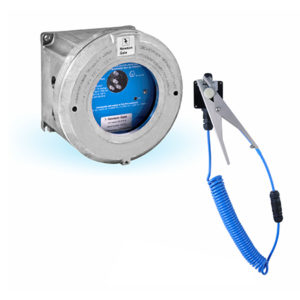
The system is designed to prevent static accumulation and discharge during the loading and unloading of rail tankers, drums, IBC's, containers, etc. Earth-Rite PLUS Single Mode ensures that correct bonding and grounding procedures are carried out before the transfer process begins. It verifies the connection and monitors the dissipation path that carries away electrostatic charges to the ground in accordance with international requirements for the control of static electricity. The system allows media transfer only when the earthing status is within pre-set parameters, thereby eliminating the potential for operator error. The local indicator LEDs confirm the earthing status to the operator, while the built-in voltage free switch may be interlocked with pumps, valves, alarms, etc. in order to interrupt the process of loading / unloading in the case of improper earthing or its absence.
During aircraft refuelling operations, the refuelling vehicle should always be bonded to the aircraft by a cable designed for this specific purpose. In addition, a dead man's control is required, i.e. a switch that cuts off the flow of fuel to an aircraft in case of a problem (see NFPA 407).
The Trans-Rite AVIATION successfully addresses these two issues in a single intrinsically safe bond connection monitoring system, mounted in the cab of the refuelling vehicle. The system incorporates a bond-monitoring cable reel and ALS-10A-IP aircraft clamp to both equalize the potential between refuelling equipment and the aircraft and to continuously monitor the integrity of the bond. Additionally, the dead man's switch is incorporated into intrinsically safe circuitry, avoiding the need for a separate system.
Type C Big Bags that dissipate static electricity are commonly used in chemical, food and processing industries to prevent excessive accumulation of static electricity, which may result in electrostatic discharges from the surface of a container or allow adjacent objects / operators to become charged by induction.
The Earth-Rite FIBC system ensures that the container is correctly earthed and within the correct surface resistivity range, before material filling / emptying commences. The resistance monitoring range of the system also enables it to be used with other “static dissipative” materials, such as flexible linings, hoses, etc.
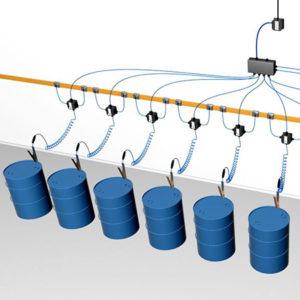
Designed for process plant and machinery, whose removable parts may become isolated conductors. Earth-Rite MULTIPOINT provides monitoring and static earthing for up to eight channels with feedback to the operator and interlocks.
Typical applications include fluid bed driers, filling / discharge equipment as well as many other items of plant where parts of the assembly must be periodically disconnected. The system maintains hazardous area and operator safety at all times using a single intrinsically safe power supply.
In certain applications Earth-Rite MULTIPOINT systems may be combined in order to monitor more than 8 channels.
The Earth-Rite OMEGA system enables engineers, contractors and OEMs to incorporate dedicated static earth monitoring as part of larger plant instrumentation and control systems.
The Earth-Rite Omega module is designed for rail mounting (35 mm, DIN standard) into control panels. The system is capable of checking resistance between two points and providing relay output switching at a user-defined set point.
Typical applications include temporary ground condition monitoring of all mobile conductive plant items and permanent continuity monitoring of fixed plant items in all flammable atmosphere zones, as well as monitoring simple devices such as float switches in hazardous areas.
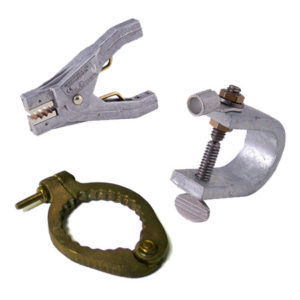
In many branches of the process industries, fires and explosions can result from electrostatic discharge in hazardous areas. Even a relatively small discharge (sparks) have sufficient energy to ignite many flammable vapours, gases or even airborne dusts. In situations where such risk exists static earthing and bonding clamps are required – in all situations where mobile or portable conductive plant items are used (such as barrels/drums and containers, etc.). In these applications, it is necessary for the clamp to make a low resistance contact with the object, to enable any static to be safely dissipated to ground via a suitable conductor before the energy available for discharge builds up. If the correct clamp has been selected for the application and the object to be earthed does not have surface insulation, then it should be possible to make good enough contact to prevent static accumulation. However, in practice, many barrels/drums, containers and other types of equipment have coated surfaces (even when new). This problem is compounded in use, due to the build-up of additional insulation layers, such as paints, resins, adhesives and other substances inherent to the processing environment.
In tests, many standard earthing clamps in use today show very high resistance readings when clamped onto conducting objects with insulating surfaces. This may result in the clamp appearing to be physically attached, but not actually performing its intended function (safe static dissipation).
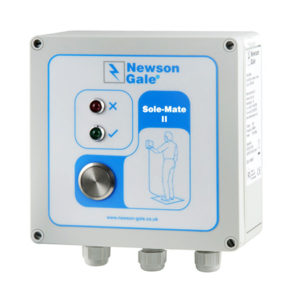
Sole-Mate is an easy-to-use device designed to check the condition of static-dissipative (anti-static) footwear prior to entering a safety critical hazardous area (potentially explosive atmosphere). The Sole-Mate mat tests continuity from the operative’s finger to the floor plate right through the static dissipative footwear. The unit is installed at the entrance to a hazardous area – it will provide a “pass” or “fail” signal depending on whether or not the resistance falls within the pre-set limits. The Sole-Mate is set to measure resistance according to the EN345 standard (lower and upper limit), but alternative ranges are also available.
The I.S. Earth Lead Tester is approved for use in hazardous atmospheres and ensures compliance with local / company standards for static earthing and bonding. The portable unit provides optical and acoustic indication of resistance levels and allows safety and maintenance personnel to quickly check the condition of earthing and bonding cables.
304 stainless steel heavy duty clamp is designed for earthing many types of containers, drums / barrels, kegs, open vessels, IBC's and mobile tankers. The clamp has twin tungsten carbide teeth to provide a reliable connection. Ideal for clean room applications or areas where high corrosion resistance is required.
ATEX certifica
Medium duty clamp with two stainless steel contacts, suited to lighter applications such as earthing and bonding of small containers, carboys and vessels. Available in carbon steel or stainless steel construction.
Commonly used in the paint and coatings industry for transferring solvents and thinners. The REB plier features hard anodized die-cast aluminium body and stainless steel points to provide a light and easy to handle clamp for attachment to small containers and drums / barrels.
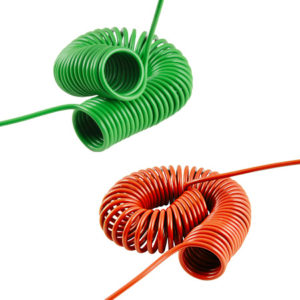
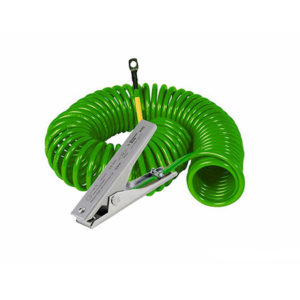
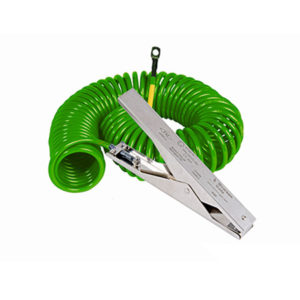
Designed to combine low electrical resistance with high mechanical strength, special grounding and bonding cables are available in a range of length from 1 to 15 meters. A hytrel chemical and abrasion resistant covering enables the cables to be used in many types of industries/applications. Cables are available in spiral extendable form or straight lengths, and colour coded green for European standards or orange for North America. The client may choose from a wide range of specialist products to obtain an optimal combination of clamps and cables for a particular application. All items can be purchased separately for self-assembly or supplied as fitted and tested assemblies.
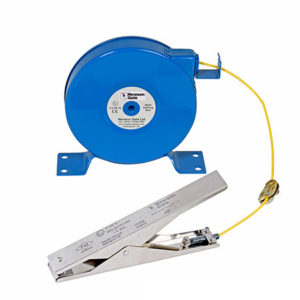
Cenelectrex static discharge reels are available in many size/length options, have a self retracting cable drum and instant lock mechanism to prevent cable becoming tangled. They are usually fitted with a Cling-On Clamp, but alternative clamps are also available, including Bond-Rite.
CMS - RobArt