


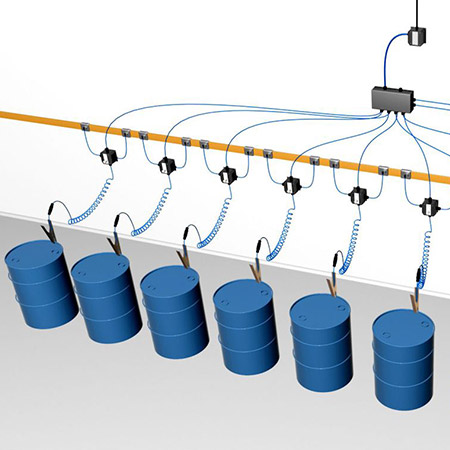
Bond-Rite Self Testing Static Grounding Clamps with Visual Indication
Applications:
- for bonding/earthing of portable/mobile plant equipment (drums, containers, FIBCs, tankers, etc.),
- plant items usually have a built-up of additional insulating layers, such as paints, resins, adhesives and other substances inherent to the processing environment, which creates a challenge to standard earthing clamps and may result in the clamp appearing to be physically attached, but not actually performing its intended function (safe static dissipation),
- the Bond-Rite clamps are in compliance with stringent safety standards and are suitable for use within ATEX zones.
0
Features & Benefits:
-
Bond-Rite grounding clamps contain a bright green LED which flashes continuously when the clamp detects the grounding circuit has a resistance of 10 ohms or less, informing the operator that hazardous electrostatic charges do not have the potential to accumulate on the equipment for the duration of the process,
-
tungsten carbide tips bite through product deposit build up, rust & or drum coatings to ensure proper bonding connections are made,
-
stainless steel grounding clamps designed to withstand use in tough chemical processing and industrial environments,
-
two conductor bonding cable in hytrel coating (thermoplastic polyester elastomer which is mechanically robust and resistant to chemical corrosion),
-
a 9V magnesium-lithium battery provides up to 6 months of power for equipment grounded for up to an average of 6 hours per day,
-
Quick Connect provides personnel with the flexibility of removing the grouding clamps from zoned/classified areas for battery replacement.
Options:
- wall mounted indicator station housed in a stainless steel enclosure (prefereable for harsh processing environments where a clamp-mounted LED indicator may be covered in dirt),
- 220/240V AC or 110/120V AC +/-10%, 50Hz mains supply is recommended for process applications that require grounding for more than 6 hours per day,
- the Bond-Rite EZ is a unique portable unit; in contrast to the standard version it features a cable with clamps at both ends ‒ one to be connected to the ground point (e.g. bus bar) and one to the item of plant at risk of static charge accumulation; when finished, the Bond-Rite can be used in another location.